Wednesday, 30 January 2013

Django Unchained (2013)

After a 4 year break, critically acclaimed bad-boy director Quentin Tarantino is back with his latest bloodbath Django Unchained. Similar to some of his previous outings, Django Unchained is a roaring rampage of revenge. Set in 1858, two years before the civil war (we're reminded), Django (Jamie Foxx) is a slave once owned by three unscrupulous criminal brothers. He's tracked down by dentist-come-bounty hunter Dr King Schultz (Christoph Waltz), since Django knows from memory the faces of these three. From there, the two form an unlikely partnership as Dr Schultz seeks bounty and Django seeks his wife Broomhilda (Kerry Washington) and those who've mistreated and abused her. Already, we have the elements of Christoph Waltz as a slick, smooth talking German in tense negotiation which made Inglorious Basterds such a brilliant film, but also the overwrought three-hours-of-revenge that Kill Bill would have been but for the production company's insistance that it be cleft into two movies since, you know, nobody would want to sit through three hours of exploitation cinema with characters more shallow than a wading pool. So, which way will Django go?

As this is the first Tarantino film I've reviewed, I'd like to briefly preface it by running down my experience with Tarantino and how I understand his filmmaking sensibilities. Tarantino burst onto the scene with Reservoir Dogs in the early 90's, it combined hardcore violence, clever symbolism, real characters, and an offbeat but strangely fitting soundtrack. 

As well as a few other Tarantino signature tropes (the trunk shot, for instance) all of his future films would carry some combination of those elements. More than anything else, Mr Tarantino's genius is not watching a lot of old classic movies, movies we think of as 'good', and then taking the good elements from them and using them in his films; Quentin spent his formative years in a VHS video store watching a lot of bad films, mostly 60s / 70s exploitation films, and from them, taking the good elements and then including them in his own films. In that way, he found an unexploited niche and made it entirely his own. 

After Reservoir Dogs and Pulp Fiction, both of which recieved considerable critical acclaim and recognition at prestegious film festivals (Cannes, Sundance etc), he made Jackie Brown, a film heavy on character, heavy on storyline and while moderate on cartoonish sensibility, still carrying plenty of Tarantino's style. Unfortunately, it was a box office flop. This stung, and poor Quentin wouldn't make another film for 6 years. When he returned, he gave us Kill Bill volumes 1 and then 2; which were on the complete opposite end of the Tarantino spectrum from Jackie Brown. Shallow characters, cartoon (literally, at points) visuals, unrealistic and explosive violence, and a simplistic sum-it-up-in-two-words plot. I was disappointed, it's not a film I enjoy watching on my own, I need a few mates around and some beer, having a laugh. Unfortunately, Kill Bill vol's 1 and 2 were box office hits, and Jackie Brown fans like myself were all a little heartbroken that we might never see another Jackie Brown again. A fear only compounded by Grindhouse in 2008.

What we did get instead is a still very enjoyable and unique film in the form of Inglorious Basterds; Tarantino found his niche in a combination of extreme violence, good characters, tense dialogue and even more tense set pieces. It didn't quite have the deep, human realism of Jackie Brown, and it did have a fair measure of the silliness we saw in the Kill Bills and Grindhouse, but without being saturated in such silliness as those earlier films were.

Enter Django Unchained. The direction Tarantino has taken is to embrace the success of Inglorious Basterds and build upon it. Django and Inglorious are really very similar films, not the least accounting for which is Christoph Waltz playing almost identical characters in both. Clearly, Tarantino was told (or knew) that Waltz (who in his native Germany was never actually considered an exceptionally talented actor) was by far the bast thing in the film, and given the tense, clever dialogue which Tarantino delivers at his best, is an engrossing screen presence.  Foxx is functional, if not remarkable, and DiCaprio gives the best performance I've seen from him since What's Eating Gilbert Grape. Considering I'm a big DiCaprio fan, this is truly high praise. Lastly, Samual L Jackson plays a villain, but, unlike anything Tarantino has done in the last decade, plays an exceptionally well balanced and complex villain, and does so beautifully, so much so that I have the boldness to say 'Stephen' is my favourite Samuel L Jackson role of his career.

These characters achieve the same sort of depth and profundity as those Tarantino gave us in Jackie Brown, but where I've changed my mind about Tarantino is that Inglorious Basterds partially, and Django Unchained completely, have lead me to embrace the silliness he uses in his films when (and only when) it's used in good measure. Where Django Unchained really succeeds for me, is including some of that silliness, but paired back enough that we never laugh at the film. I never laughed at Reservoir Dogs, I never laughed at Jackie Brown; this is the third Tarantino film I haven't laughed at, and it is truly marvelous.

The other major area in which Django Unchained succeeds is in the sound and the music. Highly stylised sound effects and unusual and creative music have always been a staple of Tarantino films; even the films of his I don't like, I have to concede that the sound effects and music render them at least watchable. Django Unchained features a well balanced blend of 60's western, R&B, and ambient music pieces which both compliment the film, and truly put Tarantino's signature on the film. 

My niggling issues with the film include the ending, which snakes around and dawdles, the incompleteness of the 'German Legend' metaphor (where was the mountain?), and Tarantino's completely unnecessary Australian Accent. Quite late on, Tarantino and another come on screen with modern Australian accent, I emphasize modern because the modern Australian accent didn't exist in 1858, Australians would have sounded English at the time. While I can embrace the unrealistic nature of bodies exploding when shot (under the Rule of Cool), I just don't understand the need or benefit of Quentin-the-lousy-actor sporting a semi-plausable Australian accent on screen. External criticisms mostly cite that the film is too long, but I don't believe so. Tarantino could have economised some time by combining some of the purely aesthetic shots with the less aesthetic dialogue shots in order to save time, but I didn't find it dragged on at any point. Even the end: I found the problem was indecisiveness on Tarantino's part, not dragging on too long.

I didn't enjoy Django Unchained quite as much as I enjoyed Jackie Brown, but I will say this: I'll be a happy little film buff should Quentin Tarantino continue his career making more Django Unchained's instead of Jackie Brown's. There are a few directors out there that could make a Jackie Brown and do a very good job of it, but only Tarantino could make Django Unchained. Tarantino offers something unique with this film. I realize that the next project he has on the cards is a third installment of Kill Bill, I genuinely hope that that's solely to cash in on a golden goose, and that otherwise the step he took from Inglorious to Django, he'll take again with an even better Tarantino film thereafter, as it now appears he's entering a golden age of his career. 


Tuesday, 29 January 2013

Salmon Fishing in The Yemen (2012)

Salmon are a fish which require cold, oxygenated water all year round in order to live and to spawn in. Naturally, a project to introduce Salmon to the hot, dry Arabian nation of Yemen is unfeasible--fundamentally unfeasible. Or is it? In this tale of hope-over-adversity and wisdom-in-absurdity, Ewan McGregor, British fisheries expert, is seconded to Yemen to do just that.

I have a problem with the writing in this film; it's really on the nose. Ewan McGregor is a charming screen presence but charm is tarnished by the really mundane lines he's given to deliver. This must have been a problem in the book from which the film was adapted, because the script is adapted by none other than Simon Beaufoy. Beaufoy is a legend in Britain with a list of academic and industry credentials as long as both your arms, and famed for penning the scripts of The Full Monty and Slumdog Millionaire. How the script has come out just so naff and implausible in the case of Salmon Fishing, I can't quite understand.

There is a wonderful performance by Kristen Scott Thomas, playing the Press Secretary to the PM, wonderfully sharp and cutting in the role. The natural grace of Emily Blunt does come through the screen, and there are some genuine laughs here and there. It's a nice movie, it's a charming movie, but it is, unfortunately, entirely forgettable. It's out on DVD now, it's a good flick to watch on a lazy afternoon with nothing better to do, otherwise unremarkable.


Tuesday, 22 January 2013

Life of Pi (3D) (2012)


About seven or eight years ago, I worked in a book store. My boss at the time, a short, solid man with little round glasses and excellent taste in literature, was reading a curious little novel by Yann Martel called 'Life of Pi'. He would look at customers and myself over those little round glasses and lavish high praise for the novel, and genuinely considered it as art in literature. Seven years later, Ang Lee has directed the movie version with what we can see just from previews and posters to be a visually stunning piece of cinema.

We could easily compare it to Hemingway's The Old Man and the Sea; a story of a castaway battling an unforgiving Poseidon and learning about life, the world, and his own humanity. While Hemingway received the Nobel Prize for Literature for that short novel, the film adaptation starring Spencer Tracy was an absolute yawn, capturing none of the romance or profundity which Hemingway gave that novel. When I first saw that Life of Pi was to be adapted, I had the same reservation, that Ang Lee would be making the same mistake the producers of T.O.M.A.T.S. made: filming a completely unfilmable book. When I first saw those posters and those previews, I made an erroneous assumption that Lee would be replacing an unfilmable narrative with pure visual punch.

It was a mistake I carried right until the last 15 minutes: it's not a spoiler to say, but there is a depth and profundity in Ang Lee's Life of Pi which was absent from the film adaptation of T.O.M.A.T.S. The problem--and it is a serious problem--is that the intense visuals and especially the 3D completely distract you from it. So much so that in the last 15 minutes, we're given some exposition of an alternative interpretation of the whole movie, and it's a possible interpretation I would have liked to, and may have, imagined on my own but for the distraction of the visuals. 

Hemingway, once asked what the old man and the big fish 'represent' in The Old Man and the Sea, famously responded:

“There isn't any symbolism. The sea is the sea. The old man is an old man. The boy is a boy and the fish is a fish. The shark are all sharks no better and no worse. All the symbolism that people say is shit. What goes beyond is what you see beyond when you know.”

The same is not true of Life of Pi, not in the film and I'd imagine should we ask my old boss, he'd look at us over his little round glasses and explain the symbolism quite pointedly. In that sense I found the 3D pushed me out of the story, rather than drew me in. 

Now I could re-watch the film in 2D, with that alternative interpretation in mind and before sitting down to write this review, that was genuinely my plan. What changed my mind was the fact that, really, I could re-watch any number of the films I've reviewed in the past, and come back with a more favourable opinion of them, but I don't. So why should Life of Pi get that privilege? After all, for those of you who read my reviews to decide whether to see the film or not, you're not looking for my opinion on what the film is like the second time you see it

Life of Pi can really be enjoyed two ways: see it in 3D and immerse yourself in the visual splendour, and don't worry about the symbolism and underlying narrative. Otherwise, see it in 2D and pay close attention to the relationships (especially early relationships) and enjoy a quite clever literary adaptation. The better or 'right' way to see it will just come down to personal taste. I don't think the two can (or perhaps should) be combined. That, I feel, is the problem with this film specifically and the problem with the use and overuse of 3D in cinema today. I liked this film, I really did, but the 3D acting as a distraction from the narrative, and at the same time giving the film visually splendour, makes me both love and hate the stereoscopic illusion all at once.

To wrap up I also should mention the brilliant and caring performance by lead Suraj Sharma; so much is demanded of him, he really is asked to carry the entire film acting against an empty space which will only later be filled in with a CGI tiger. It's a monumental task, but he does it, delivering a wonderful, measured performance. The pace of the film, too, is well measured; it doesn't waste time, but neither is it rushed. Again, I really did enjoy this film, I imagine I'll enjoy it even more the second time around, but for now I'm giving it four stars.


Monday, 21 January 2013

Gangster Squad (2013)

In this late-40s gangster piece, Josh Brolin (son of James Brolin) plays an Irish-American no holds barred cop in a world of East Coast, wild west corruption. LA Kingpin Mickey Cohen (Sean Penn), has the ambition of ruling over all of LA and buying every cop for sale and doing away with the rest; only Brolin's John O'Mara and his carefully arranged team of age- and race-balanced cohorts can stop him.

I guess you can detect already my cynicism for this film, it's very cliched. Really, beginning to end we have an entirely predictable gangster flick, considerably more stylized than it's predecessors (you can tell from the posters: it's a sort of neon-lit plastic-fantastic noir which reminded me of Tim Burton's Batman series; just think of it as Batman Forever without Batman). The film employs the most overused and boring tropes of the crime fiction genre, and I found myself looking at my watch far more often than anyone should in an action blockbuster.

The best thing in the film is Ryan Gosling as the young chain-smoking hot-shot, he plays the role incredibly well (I've done a complete 180 on my opinion of Gosling since The Ides of March). Emma Stone is Gorgeous, and Josh Brolin does something better than the really quite good Tommy Lee Jones impersonation he gave us in Men In Black 3. Perhaps the worst is seeing Sean Penn and Nick Nolte, both truly gifted actors, wasted in their respective, trite roles.

Briefly I also want to mention the target audience: who the hell is it? The film had the overly-stylized, fast-talking quip-spouting tough-guys vs tough-guys sensibility of a film aimed at male teens, but the amount of violence (quite gory at times) precludes it from a rating low enough for that audience to attend (getting away with an MA15+ in Australia, but an R in the United States). I simply do not understand who, precisely, the film is made for.

Gangster Squad is a pedestrian attempt at a period action blockbuster. It's currently number 4 in US box office sales, but I do genuinely believe that that has much more to do with promotion and the posters, than the quality of film or any sort of word-of-mouth popularity. Don't bother with this one.


Wednesday, 16 January 2013

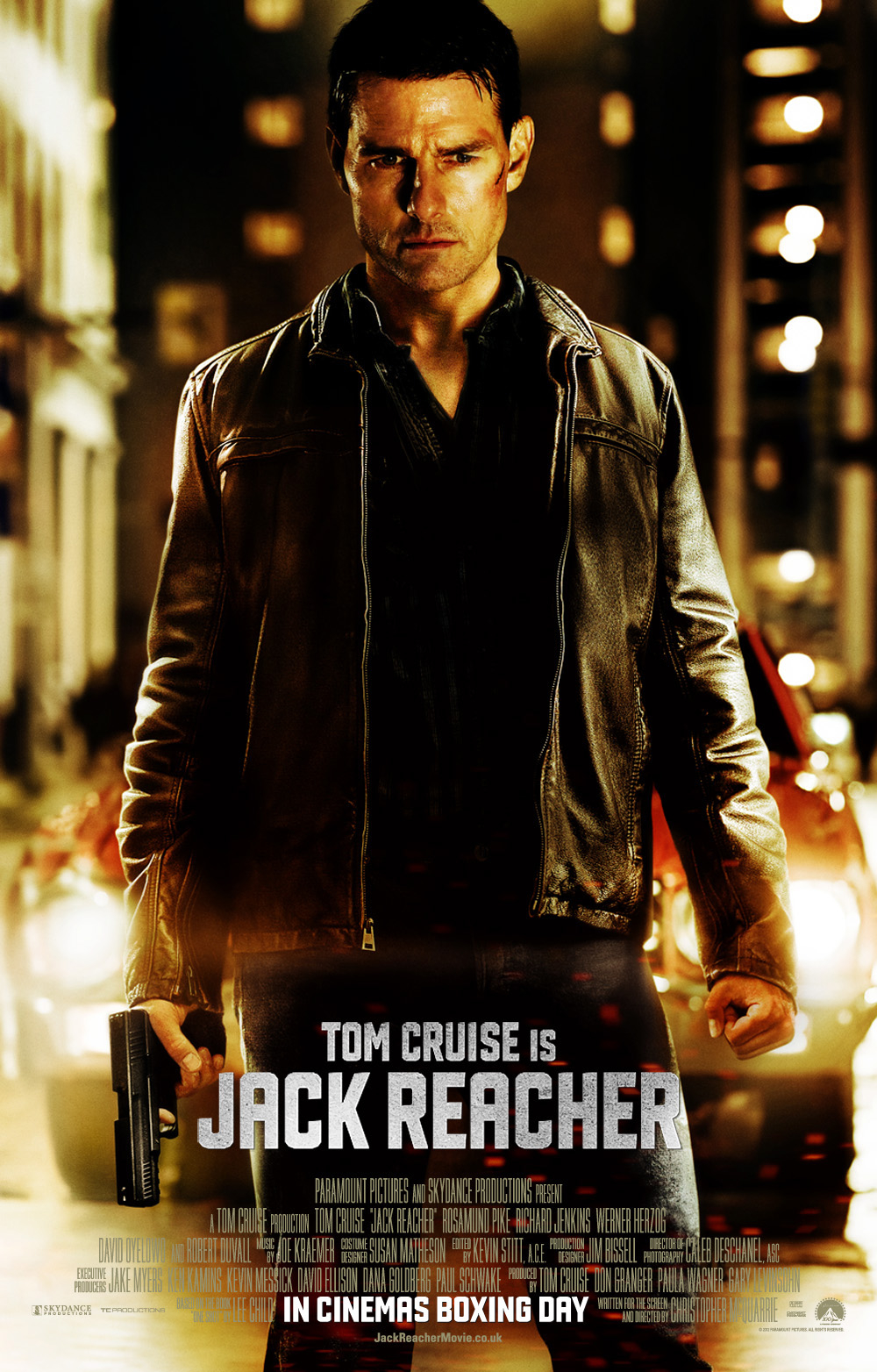
Jack Reacher (2012)

Jack Reacher, retired military police officer, drifter, and pro-badass, is asked by a deranged gunman to help him after shooting 5 random people in cold blood. But everything is not as it seems, and only Reacher can get to the bottom of this twisted tale of lies, violence, and the irrepressible will to be.

That is a consistent theme through the film; the will to exist and live out our nature, even when our nature hurts others. It is why, in my opinion, Werner Herzog signed up for a role. I think it's a very literary theme that probably would have been done excellently in the book upon which the film is based ('One Shot' by Lee Child, which I never read), and it still worked for me in the cinema.

What I really want to talk about is the performances. Tom Cruise was an odd choice as the title character, as Jack Reacher in the novel is only ever described as 6'5'', but I liked him. Cruise usually runs the risk of being too 'douchey' if I may take the liberty, and that 'douchey-ness' is what made Jerry Maguire such a pile of garbage; despite this, and despite the flippant insults his character spouts beginning to end, I still liked him, and I can't quite explain why. Werner Herzog is a wonderful, frightening screen presence in every scene in which he appears, and his thick Bavarian brogue gives the sort of depth and profundity you can find in his documentaries (despite the fact he's meant to be a Russian, work that one out). The let down is Rosamund Pike as the love interest. Her character 'Helen' is a film noir blonde bombshell, with daddy the district attorney and herself a struggling single female lawyer, and at one point sporting the noir belle trio of golden curls, trench coat and cleavage. All of that is fine, but she just cannot act. Any time 'Helen' appeared on screen, I genuinely wanted to chew my fingers off.

Visually the film is very good, and I suspect rookie director Christopher McQuarrie took a lot of advice from his DP, the much more experienced Caleb Deschanel. The opening establishing shots are very beautiful, so much so that we don't actually get any dialogue for the first five or ten minutes, and none was needed.

Jack Reacher shows a lot of potential. It's a lot of fun, we're given some great action sequences, the plot is interesting and engaging, but unfortunately it's a little inconsistent as a package. If you see it on DVD, stick around for the action sequences, make your tea and sandwiches when Helen and her dad appear on screen.


Monday, 7 January 2013

New Years Triple: The Campaign / Pitch Perfect / A Royal Affair (2012)

The Campaign (2012)

 Out on DVD is the latest Will Ferrell comedy, this time taking a shot at US politics. As a US politics junkie (so much so that I hold election day parties for US presidential elections), I should have been looking forward to this, but for reasons I can't quite explain, something about the way the film was promoted gave me a bad feeling about this one.

Unfortunately, I wasn't won back over after actually seeing the film either. American politics is such an easy target to lampoon, yet they've managed to make a complete mess of it. What I was hoping for was a film made in the spirit of an SNL sketch, or the second segment from an episode Daily Show with Jon Stewart, and builds a feature film with it. Instead, what we're given is a second-rate Will Ferrell slapstick-and-fart-joke movie that just happens to have a political theme. That theme could have just as easily been a sport, or some other industry, and with a few minor changes we would have had the same movie.

The one redeeming feature I found was a rather clever sniping of the Koch brothers (billionaire mogul's who have an enormous influence on US public policy), performed admirably by John Lithgow, who is perhaps the best part of the film, and Dan Akroyd, partly reprising his role from Trading Places. Aside from that, it flops. Vote this one out.


Pitch Perfect (2012)

Beca is an aspiring DJ, longing to spin the vinyl in California, but for now must attend college on the East Coast. At Bardem, she happens upon a struggling group of a capella singers called "The Bellas" and after some jostling, joins. As a DJ, Beca's passion is to mash-up tracks which have the same chord progression and creating a terrific new sound. Beca wishes to import this concept into the a capella group but is struck down by alpha bitch Aubrey. That conflict, and The Bellas' rivalry with cross-campus crooners "The Treble Makers" provides our story arc.

Expecting a movie-length glee, and put off by the tacky tagline "Get Pitch Slapped" I was truly amazed by how much I enjoyed this film. The laughter rate is astounding, I don't think I went 5 minutes without a good belly laugh, and Aussie star Rebel Wilson, who is always at risk of being completely annoying, brings a girl-power-gusto which is both hilarious and admirable. We're treated to what could be dozens of musical numbers, some for only seconds at a time, and the toe-tapping energy of the music is completely infectious.

Even better is the feminist sensibility the film carries. The Bechdel test is passed within minutes, and misogyny is treated as something so outdated and stupid, it's there to be ridiculed. Pitch Perfect feels, beginning to end, like a film written by women, about women, but for everybody; it makes a comment on women's position in society without having us feel like we're being lectured to by a feminist speaker, and that really deserves praise. My one reservation with regard to social commentary is the treatment of Asian characters; there are two with significant screen time, and both are portrayed as some sort of alien life form, completely out of touch with the norms of human interaction. I hope it was just a coincidence, and I'm sure it is. 
If, like me, you've never sat down and watched an episode of Glee, go along and see Pitch Perfect. Then, like me, you'll never feel the need to.


A Royal Affair (2012)
Starring Mads Mikkelsen and receiving much critical acclaim, I had been meaning to sit down and watch Danish period drama A Royal Affair for some time; when Mark Kermode listed it as his equal favourite film of 2012 (along with Berberian Sound Studio), I wasn't going to let another day pass. A Royal affair is the story of an Englishwoman bequeathed to Christian VII of Denmark. What follows is a dysfunctional relationship between the King, Queen, and the King's personal physician Struensee (Mikkelsen), secretly an enlightenment-era thinker and critic in the vein of Voltaire or Rousseau (who do indeed come up in the film) who publishes letters and pamphlets anonymously.

The dysfunction comes in quite a bizarre form: Christian is in a state of arrested development, a permanent child, who refers to his wife Caroline as 'mother' as soon as she bears a child. Unwilling bride Caroline (Alicia Vikander) falls in love with Struensee. Struensee uses his influence over the child-like king to have enlightenment-inspired policies passed, and comes to wield so much influence that we clearly see him become a father figure over the King, completing an unsettling mother-father-child dynamic between the three.

This structure brings up an Oedipal theme, but does so from a completely fresh way. The dysfunction of the royal family and the ways by which the King is manipulated mirror the dysfunction of a brutal, medieval Europe persisting in the Enlightenment era in Denmark. However, the human nature and human desires of our three main players is what will ultimately undo their work to make Denmark the 'Light of the North'.

This isn't Mekkelsen's best performance, but certainly not his worst. He is out-shined by Mikkel Boe F
øelsgaard as the man-child King, and Føelsgaard is in turn out-shined by a magnificent performance by Alicia Vikander. Outwardly, she is vulnerable and timid; inwardly she has a strength which is difficult to define, it's not so much a strength, but a potential for strength, like a waking dragon. The scenery is, at times, absolutely gorgeous, and some shots look just like a Monet (fitting, as impressionism was the principle art movement of the enlightenment; that sort of detail I just love).
A Royal Affair demands an audience, and I can't hold back my enthusiasm for such a magnificent and stunning film. It's out on DVD now, so you have no excuse.
    

Tuesday, 27 November 2012

Skyfall (2012) [SPOILERS]

This review will be quite different to my typical reviews: I'm going to spend a lot of screen space comparing the latest Bond flick, Skyfall, with Christopher Nolan's Batman movies.  Because of this, there will be spoilers and lots of them.  So, if you haven't seen Skyfall nor the full Dark Knight trilogy, don't read this review.  If you have, then I have some interesting and surprising points to bring up.

When reviews of Pierce Brosnan's later Bond films started to turn sour, EON productions looked at the market and what was successful at the time for inspiration to reinvent Bond.  What they looked to was the Bourne franchise: a realistic, exposed-wires world of espionage where the hero needs to really work hard to make things go his way.  Bourne was often a vulnerable character, often in serious peril and would need to literally fight his way out using his fists, walking away with bruises and a split lip.  When this filmmaking sensibility was ported into the James Bond franchise, the result was Daniel Craig's parkour-proficient, poker-playing Bond, and what has been called a 'renaissance' in the franchise.  Many are calling Daniel Craig the best Bond ever.

As the Bourne franchise winds down, the producers have decided not to rely on their own creativity, but to look elsewhere, and after having seen Skyfall, it's clear to me exactly where they took their inspiration: Christopher Nolan.  Released only months apart, Nolan's The Dark Knight and the Bond installment Quantum of Solace shared strong opening weekends, but TDK went on to Gross more than three times the amount QOS was able to bring in.  Clearly, the EON interpretation of this was that Bond was no longer at the cutting edge of action cinema, and that for the next installment, Nolan's narrative style should be mimicked as closely as possible.

Who's a pretty boy?
First, we see bond even more weakened and even more vulnerable, and spending a long period in such a state, not at all dissimilar to the period of dark brooding Bruce Wayne experienced in The Dark Knight Rises.  This genuine period of angst and dishevelment gives so much more weight to the Batman and Bond characters when they finally do return to full flight.  The villains are created with the same purpose in mind: to make the audience feel a little unsettled and a little creeped out by them.  While Nolan and Australia's late Heath Ledger made The Joker the epitome of 'unsettling villain', the team behind Skyfall looked to another unsettling villain: Javier Bardem's Anton from No Country for Old Men.  In all three films, our villain is a single-minded weirdo with funny hair who can, with as little as a glance, creep us out.


Oh... what was your name again...?
Then there is the role of the two organizations: MI6 and The League of Shadows.  Equating the two puts M in the role of Ra's Al Ghul.  They are of course, differently aligned organizations, but the consistency lies in the fact that in both franchises, our main hero and our main villain both spring from the same place.  Both Bruce Wayne and Bane come from the same shadowy organization and both climbed out of the same 'pit' (dungeon or bat-infested well), similarly, both Bond and Silva come from the same shadowy organization, and both have been left for dead by it.  It is how these four deal with the pathos of this origin and this treatment which determines their alignment to either good or evil.

Essentially, Skyfall is The Dark Knight trilogy condensed to a single movie.

That aside, is it an enjoyable movie to watch?  I think so.  More is asked of Craig this time around than in any previous outing, and the same is true of Dame Judi Dench; both actors fulfill this calling and make it look easy in the process.  Mendes successfully creates a series of suspenseful action sequences, which are entertaining and kept my attention.  There is a dry British wit which is (and should be) associated with Bond films, added in the right doses, and the set design (particularly the Macau casino sequence) planted the story in a truly gorgeous setting, befitting a franchise audiences historically associate with beautiful, exotic locations.

The team behind Skyfall have made an entertaining film which will stand up beside its peers in Bond's 50 year (and counting) history.  They've done it, though, by being lazy and derivative.  How forgivable is that sort of laziness when the audience is still thoroughly entertained?  That question can only be answered by you the individual.  I'm giving it three stars.